Mostrando entradas con la etiqueta computing. Mostrar todas las entradas

viernes, 13 de abril de 2018

Care about your data!!!

Over 90% of the world's data was created in the last three years and by 2020 it is estimated that there will be 30 billion connected devices - all collecting data.
Our search history, contacts lists, website visits, are all being collected and often sold on.
Data can be sold and used for targeted advertising, but it can also be used to improve infrastructure and shared knowledge. It's also used to teach and improve artificial intelligence (AI).
But who owns this data? Many of us agree to giving our data away to companies when we agree to their terms of use. For some of us, this may seem like a small price to pay for a 'free' service.
But should we be giving this data away so easily?
Should we be able to trade our data for goods and services - or even treat it like a currency that we store in data banks?
If the future is being driven by data, then to own the future, we might well need to own our data.


domingo, 25 de febrero de 2018

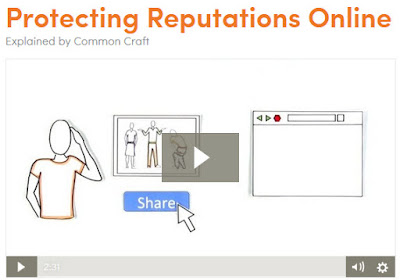
Protecting reputations online

This video discusses the long-term risks of sharing inappropriate information on the Web. It encourages viewers to “think before you click” and offers tips for being responsible with photos, video and stories
https://www.commoncraft.com/video/protecting-reputations-online

miércoles, 2 de noviembre de 2016

How Search Engines Work

Ever wonder how search engines like Google, Yahoo! or Bing can find and deliver results so quickly?  Learn more about how search engines work with this infographic


martes, 20 de septiembre de 2016

Find the Technology

This game enable you to develop computer-related vocabulary.
You must locate objects scattered in a room and, when the object is located you´ll have to select a definition that best describes the object.
All objects, descriptions, and questions have audio support and can be read aloud to the player.
Have fun and try to find all the objects in a few attempts possible!

http://www.abcya.com/computer_vocabulary.htm

martes, 14 de junio de 2016

Input and Output devices

We use different computer devices every day. Some devices are used to input information, while others are to output information from our computers. 
With this game, you will learn about 3D printers, scanners, projectors and more!

http://www.abcya.com/input_output.htm

sábado, 19 de marzo de 2016

viernes, 19 de febrero de 2016

How do hard drives work?


The hard drive in your computer  can hold more information than your local library.

But how does it store so much information insuch a small space?

lunes, 15 de febrero de 2016

The Skype Translator

The beginning of the end for language classes?
The immensely popular internet phone and messaging service Skype has approximately 300 million monthly global users. For its next trick, the Microsoft-owned service plans to break down language barriers by automatically translating multilingual voice calls. This bold claim is backed up by some impressive technology.
Usinga combination ofexistingspeech recognition, text-to-speech and machine- translation technology, the program will translate any word you utter into a text format of the desired language. Current translation programs use a similar system but can currently only work if they are in the same room. The new Skype software will look to change that, allowing for fully translated international calls.
One stumbling block is the vast amount of different dialects and accents used all over the globe. Because of this, some say there will always be a need for human interpreters as computers can never be completely accurate to detect the really subtle language variations.
The translator is scheduled to be released for the public on Windows 8 by the end of the year, though you can sign up for the Preview version. Other companies such as Lexifone, Google and NTT DoCoMo are working on a similar system. Skype Translator is intended to help in all areas from education to business to international relations. Or maybe just to help you and your German exchange buddy communicate better.

lunes, 1 de febrero de 2016

Input and output devices

 Do you know the main peripheral devices?


(Click on the image to enlarge it)

miércoles, 23 de septiembre de 2015

What is the World Wide Web?

The World Wide Web is used every day by millions of people for everything. But what is it exactly? In this video it is described  as a virtual city that everyone owns and explains how it's organized in a way that mimics our brain's natural way of thinking.

sábado, 19 de septiembre de 2015

Is "Big Data" a big problem?

There is a mind-boggling amount of data floating around our society.

How in the world can we organize all of this information in a way that people can use it and learn from it?

How can we store the massive data?

Is big data a big problem?

viernes, 27 de marzo de 2015

lunes, 2 de marzo de 2015

viernes, 20 de febrero de 2015

Hardware and software

HARDWARE 
The basics of computer hardware and what the hardware does inside the computer. Discusses RAM, hard drive and processor using a house metaphor. 
 
SOFTWARE
A short explanation of how operating systems and programs work together to make computers useful and customizable.

miércoles, 21 de enero de 2015

My brainshark

Transform your static resources into dynamic and voice-enriched video presentations.
Learn how to do it in this tutorial

lunes, 15 de diciembre de 2014

The Teacher’s Guide To Keeping Students Safe Online

Most students are familiar with and active users of mobile technology. While it does facilitate sharing and knowledge exchange, it can be a dangerous tool if improperly used.
So it´s important to identify boundaries that should be set.

http://www.edudemic.com/student-online-safety-guide/

martes, 9 de diciembre de 2014

lunes, 1 de diciembre de 2014